



A lead comes in. Marketing celebrates. Sales gets to work. Then, a few days later, someone asks, “What happened to this lead?”
Now the hunt begins. Someone checks the CRM. Another person searches WhatsApp. Someone else looks through an email thread. The salesperson remembers speaking to the prospect but can’t find the details.
This is where revenue starts leaking.
B2B buyers rarely follow a straight path from first interaction to purchase. McKinsey found that B2B buyers use an average of 10 or more interaction channels during their buying journey. When these interactions and customer details sit across disconnected systems, teams lose context and opportunities slip through the cracks.
This is why businesses need more than lead generation. They need a connected revenue engine that can move every lead for revenue generation from initial interest to closed business and beyond.
What Is a Revenue Engine?
Simply put, a revenue engine is the connected combination of people, processes, data and technology that moves prospects towards revenue.
Think of it like an actual engine. Marketing creates demand. Sales converts that demand. Customer-facing teams retain and grow accounts. Data connects all these moving parts.
| Revenue engine component | What it does |
| People | Defines ownership across marketing, sales and customer teams |
| Processes | Creates a consistent path from lead to revenue |
| Data | Provides visibility into customers, activities and performance |
| Technology | Connects systems and automates repetitive work |
Without these connections, every team may be working hard, but the revenue journey remains fragmented.
A connected revenue engine should help answer simple questions: Where did this lead come from? Who owns it? What interactions have taken place? Where is the opportunity stuck? What needs to happen next?
The answers shouldn’t require searching through five different platforms.
Why Does the Lead-to-Revenue Process Break?
The biggest problem isn’t always a lack of leads. It’s what happens after the lead arrives.
Marketing may focus on generating leads. Sales focuses on conversion. Customer success focuses on retention. Each team has its own targets, tools and processes. But the customer doesn’t experience these departments separately.
They experience one journey.
A prospect might discover your business through search, respond to an email, speak to a salesperson, ask questions on WhatsApp, attend a demo and negotiate pricing before making a purchase. If these interactions aren’t connected, important context disappears between handoffs.
The problem becomes even bigger in B2B sales, where multiple stakeholders and longer decision cycles are common.
Sales teams also lose significant time to administrative work. Salesforce research reports that sales representatives spend only 28% of their time actually selling.
A better lead-to-revenue process connects these activities so salespeople spend less time finding information and more time moving opportunities forward.
How Does Revenue Operations Connect the Revenue Engine?
This is where revenue operations come in.
RevOps brings marketing, sales and customer-facing operations together around shared processes, data and revenue goals. Instead of each team optimising its own part of the funnel, everyone works towards improving the complete revenue journey.
A practical revenue operations strategy needs three things:
Shared goals: Marketing, sales and customer teams should understand how their work contributes to revenue.
Clear handoffs: Everyone should know when a lead becomes sales-ready, who owns it and what happens next.
Connected data: Teams should work from the same customer and pipeline information rather than maintaining separate versions of the truth.
For B2B revenue operations, this alignment becomes particularly important because a single deal can involve multiple people, departments and touchpoints.
RevOps isn’t about creating another layer of management. It is about making the existing revenue process work better.
How to Build a Connected Lead-to-Revenue Process
Start by mapping the complete customer journey instead of looking only at lead generation.
A typical lead-to-revenue process could look like this:
| Stage | What happens | Desired outcome |
| Lead captured | Lead enters from website, campaign, referral or marketplace | Lead is recorded |
| Qualified | Sales evaluates fit and intent | Qualified opportunity |
| Assigned | Lead reaches the right salesperson | Clear ownership |
| Engaged | Sales follows up and understands requirements | Active conversation |
| Proposal | Pricing or solution is shared | Buying decision begins |
| Negotiation | Objections and commercial terms are addressed | Agreement reached |
| Closed won | Customer makes the purchase | Revenue generated |
| Expansion | Business identifies repeat or upsell opportunities | Additional revenue |
The important part is what happens between these stages.
A new lead should be assigned automatically. Follow-up reminders should trigger without relying on memory. Opportunities that remain inactive should be visible to managers. Customer conversations should remain accessible even when multiple team members are involved.
This is where automation makes a difference.
Effective lead-to-revenue management isn’t about tracking every possible activity. It is about ensuring the right activity happens at the right time.
Which Metrics Should a Revenue Engine Track?
A revenue engine needs more than a lead count to determine whether it’s working.
| Metric | What it tells you |
| Lead-to-opportunity rate | How effectively leads become genuine opportunities |
| Opportunity-to-win rate | How well sales converts opportunities |
| Sales cycle length | How quickly deals move towards revenue |
| Pipeline value | Potential revenue currently being pursued |
| Sales velocity | How quickly revenue moves through the pipeline |
| Revenue by source | Which channels generate valuable business |
How Does CRM Support Revenue Operations?
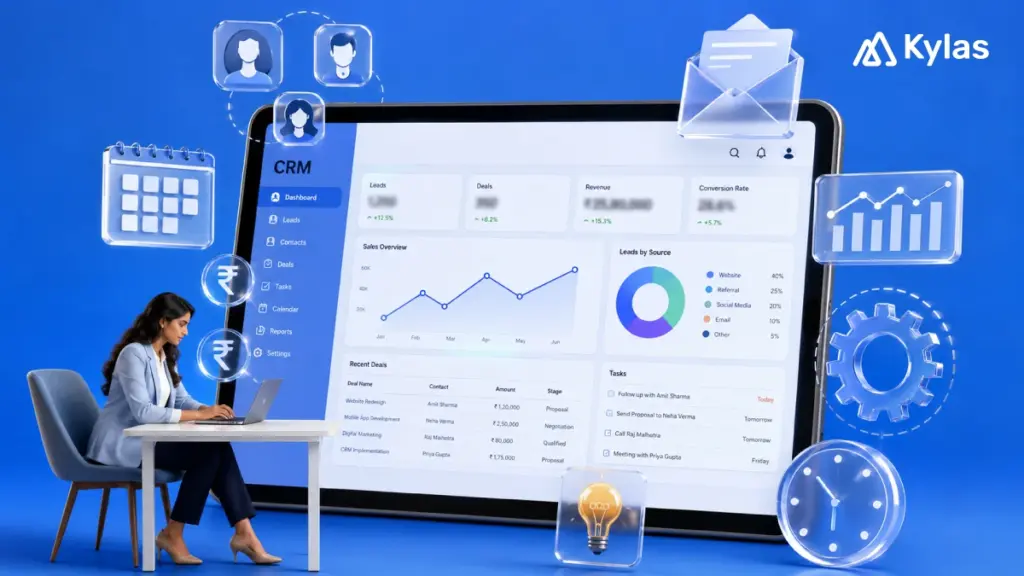
A CRM can act as the operational centre of the revenue engine.
Instead of marketing storing lead information in one platform and sales managing conversations somewhere else, a connected CRM brings customer data, communication and pipeline activity together.
A CRM can help teams:
- Capture leads from multiple sources.
- Automatically assign and route leads.
- Track opportunities through defined stages
- Record calls, emails and WhatsApp conversations
- Automate follow-ups and routine tasks
- Monitor pipeline movement
- Identify stalled opportunities
- Analyse conversion and sales performance
Building a Connected Revenue Engine with Kylas
The biggest challenge for growing businesses isn’t always generating demand. It’s managing everything that happens after the lead arrives.
Excel, email, calling tools and WhatsApp may each work individually. But managing the complete customer journey across them creates gaps, delays and unnecessary manual work.
Kylas brings the sales journey into one connected CRM. Teams can capture and assign leads, manage pipelines, automate workflows and track customer interactions from a single platform. Its native WhatsApp capability keeps conversations within the sales workflow, while integrations help connect other business tools.
Kylas also supports 70+ integrations and unlimited users, helping growing businesses bring their teams onto the same revenue system as they scale.
The result is a simpler way to manage the journey from lead for revenue generation to closed business.
Instead of asking, “Where did this lead go?”
Your team can focus on the more important question:
“What needs to happen next to move this opportunity towards revenue?”
Ready to build a connected revenue engine? Explore Kylas and bring your leads, conversations, sales pipeline and revenue process together in one place.
FAQs
1. What is a revenue engine?
A revenue engine is the connected system of people, processes, data and technology that helps a business move prospects from initial interest to revenue while supporting retention and growth.
2. What are revenue operations?
Revenue operations, or RevOps, aligns marketing, sales and customer-facing teams around shared processes, data, technology and revenue goals.
3. Why is revenue operations important for B2B businesses?
B2B sales often involve multiple stakeholders, longer buying journeys and several communication channels. Revenue operations connect these activities so teams can manage the customer journey consistently.
4. What leads to revenue management?
Lead-to-revenue management is the process of managing and improving the journey from lead generation and qualification through opportunity management, conversion and post-sale growth.
5. How does CRM support revenue operations?
A CRM creates a central system for managing leads, customer information, communication, pipelines, workflows and reporting. This gives revenue teams greater visibility while reducing manual work.
6. How can businesses improve their lead-to-revenue process?
Businesses can improve it by defining clear stages, assigning ownership, standardising handoffs, connecting customer data and automating repetitive activities.


